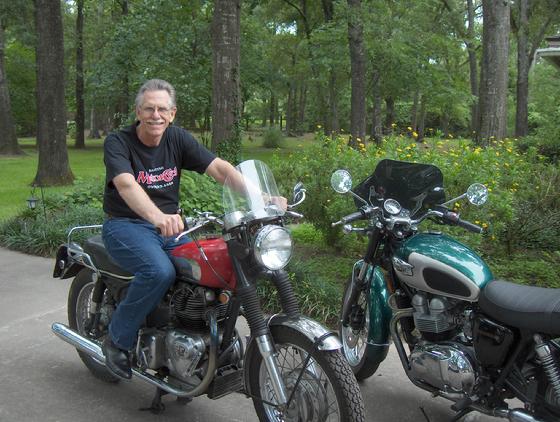
Hello and welcome to my web site. My name is Bill Bath and I am the Gadget Engineer. I am a Mechanical Engineer living in Houston, Texas and for more than 30 years I have been designing and inventing new machines. Most of these machines have been related to the offshore oil business and to nuclear waste clean-up, but the kind of machines I like the best are classic British motorcycles and robots.


Younger, newer riders might be interested to read about how things used to be for Bikers in the 60s and 70s. My experiences are detailed below: 


Reflections on Fifty Years of Motorcycling

By Bill Bath


As a card carrying member of the first wave of the Baby Boomer generation, I will grudgingly reach the ripe old age of 65 this year. I recently read that 10,000 people will turn 65 every month for the next 10 years. This fact brings a reflective state of mind. I think it is a good time to look back on my fifty years behind the handlebars. The face of motorcycling has changed a great deal since I started riding in 1961. In those days, motorcycle riders were often viewed by the general public as low class, no class, or second-class citizens. Motorcycle riders were thought of as hoodlums and trouble-makers. 1950’s movies like Motorcycle Gang and The Wild One with Marlon Brando reinforced the idea that we were all just one step away from reform school. In those days, if you saw a guy on a motorcycle he was probably wearing a mechanic’s uniform. Today, that guy on motorcycle could just as easily be a doctor, a lawyer, or an engineer.   


The fact that so many riders are now educated people may be one reason that you rarely see a motorcyclist being pulled over by the police. In the 60’s and 70’s it was common to be stopped and be “hassled by The Man.” The police watched us constantly and there were a lot more police on the street in those days. It was common to get pulled over for accelerating away from a stoplight too fast or making too much noise. If you made a turn faster than the policeman though necessary, you would get stopped for a lecture and maybe get a ticket for reckless driving as well. If you had straight pipes they would write you a ticket. If you had a muffler they would shine a flashlight down in it to see if the baffles had been modified. Today, so many bikes are running with loud pipes that it’s surprising to see a motorcycle before you hear it.


Motorcycles in the “old days” were so simple that just about anyone could do their own maintenance work and keep one running. Taking the head off to clean out the carbon or adjusting the points was no big deal. No one needed anti-lock brakes because very few motorcycles had brakes good enough to lock the front wheel. No one had an electric starter. Lots of bikes didn’t even have a battery. Everyone’s bike leaked oil. It was only a question of how much oil it leaked. Of course this rule didn’t apply to BMW’s. The joke was that they were so oil tight, every two weeks you had to take a quart out! Harleys, on the other hand, were notoriously bad about throwing oil off the chain onto the rider’s back. Today, motorcycles are so complicated that you need special training to even identify the problem, much less repair it. The electronic engine management system on most modern bikes is so sophisticated that motorcycles start easier and run better than ever. On the other hand, modern bikes run perfectly until the day the black box fails and then there is nothing left to do but take it to the dealer. The old bikes were less reliable but they generally give some warning that a problem was developing.      


When I started riding, no one wore a helmet. The only riders that even owned helmets were racers and motorcycle police. When helmet laws were first enacted (1970 in Texas) I bought my first helmet. It was a lot thinner construction than the helmets of today, but at least it kept me from getting a ticket. In a way, I’m glad that I had to get a helmet. I learned that a helmet streamlines your head and really reduces neck strain on long rides. I think that wearing a helmet should be a personal choice and not a law. Still, I think everyone would be smart to wear one.


In the 60’s motorcycle shops were just that. They sold motorcycles and parts. They didn’t sell clothes and the limitless supply of lifestyle gear and accessories. They didn’t sell motorcycle jewelry or designer boots. Girls mostly rode on the back of motorcycles. You seldom saw a girl rider because most girls couldn’t kick start a bike. I remember the first time I read about an electric starter for a ladies’ motorcycle. A guy in California put a small electric starter on a 500cc Triumph. He had to put compression releases on both cylinders so the electric starter could get the engine spinning with no compression before releasing the lever so the engine could fire. Modern motorcycles with reliable electric starters have allowed lots of women to join the ranks of motorcycle riders.


Back then, every ride was an adventure. You never knew when you might break down so you prepared yourself and your bike. Before departing on a road trip, you would tune up your bike and pack spare parts and tools. Maybe this was just a totem against breaking down but you rarely needed anything that you brought with you. The Honda 4 of the early 1970’s changed all that. The 750cc Honda 4 was a reliable bike that you could ride anywhere. Honda actually changed the face of motorcycling forever with their “You meet the nicest people on a Honda” campaign. Their little red 50cc motorcycles were everywhere. It was hard for people to see someone riding one of those little bikes and think of them as a hoodlum or an outlaw.


Overall, motorcycling has never been better. There is a style of bike for every taste. Now, with electronically controlled engines, anyone can ride a motorcycle without knowing anything about how it works. Press a button and it starts. Press a button and it stops. In between, it runs great. Anti-lock brakes make it safer than ever. GPS keeps you from getting lost. Cell phones keep you from getting stranded. Built-in stereo keeps you entertained. Some cruisers have engines bigger than a lot of cars. Today’s crotch rockets are blindingly fast. The dual sport motorcycles are also a modern innovation (but not one I really understand).  Motorcycling has become an acceptable pastime. It is truly a sport than can be enjoyed by everyone. I don’t know abut others but this Boomer is entering his golden years doing a wheelie (OK, mentally!) Motorcycling is still a heck of a ride.  


My '69 RE Interceptor and '01 Bonneville
Mower Gadget (before adding electronics)

I enjoy going to classic motorcycle rallies and my Motorcycle Stories page describes some of the best events along with pictures of the bikes. These stories include rallies in Texas, Daytona, Mid-Ohio, and England.

 My Robots page is dedicated to robot events and my current project the “Lawnbot” robot lawn mower. I hope you will enjoy my story of the Battle Bots in Las Vegas.


I think that home-built motorcycles that combine existing components into new and unusual machines should have special recognition so I have created a Motorcycle Specials Page to showoff the best ones that I have seen.


Finally I have listed the patents that I have been awarded and the technical papers and magazine articles that I have written on my Professional Recognition page. The information on this page is presented simply to provide some background into my engineering experience.


I hope that you will find something of interest in these pages. If you are working on an interesting motorcycle or robot project and need a “reality check” or a bit of mechanical advice then send an email bill@gadgetengineer.com and maybe I can help. Be sure to include a description of your project and some indication of your experience level.


If you have a “Special” bike and would like to display it on my Motorcycle Specials page please email some photographs and a little history or description of your Special to bill@gadgetengineer.com . I’ll be happy to add it to the page. If you see a picture of your bike on this page and want to add some history or information please let me know. If you don’t want your bike’s picture here then let me know that too.


THIS SITE UPDATED: 1/16/11